


by Everett 2/5/2018
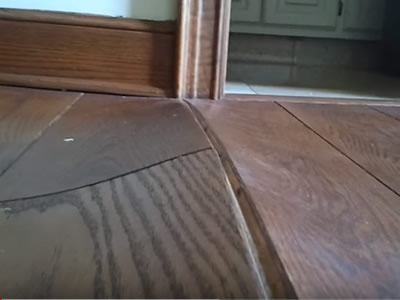
Understanding the relationship between wood and moisture is a crucial aspect of having wood flooring installed in your home. Not only can extreme swings in moisture be disastrous, even mild fluctuations can cause a floor to perform less than ideally. Simply put, one of the main purposes of wood in a tree is to transfer water from the roots to the leaves, which is done through capillary action. In other words, a floorboard's width is relative to its moisture content. This means that an increase in moisture content will cause the boards to swell against each other which can result in cupping, crowning, or even buckling. In extreme cases this can even lift entire cabinets and damage stone coutertops. Conversely, decreased moisture content can cause the boards to shrink, resulting in unsightly gaps or even cracking down the middle of individual boards in some cases.
Acclimation/moisture readings
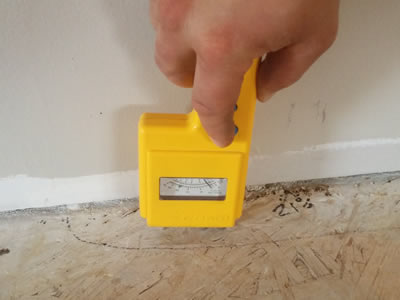
Many years ago the general rule of thumb was to simply deliver the appropriate amount of wood flooring to the home one week prior to installation. The purpose of this was to allow the wood to "acclimate" to the house. In many cases this is a perfectly adequate practice and won't lead to any long term problems, but most professional companies these days take it a step further and use a moisture meter to precisely measure the moisture readings of the wood and the sub floor of the home. These readings must be within a specific range of each other to avoid problems. Unfortunately sometimes even using a moisture meter isn't always a guarantee due to the rapidly changing relative humidity in the shoulder seasons.
Relative humidity
Apart from anomalies like plumbing and roofing leaks, the moisture content of wood in a home is directly tied to the relative humidity (Rh). Much like humans, wood has a certain Rh comfort zone at which it is the most stable- between 40% and 60%. As mentioned above, if the Rh is outside of that range, wood will either expand or contract, which is not good for the overall life of the floor. For the long term health of the floor one should consider regulating the Rh year round with either a dehumidifier or humidifier, or both, preferably integrated with the home's HVAC system.
Cupping/crowning
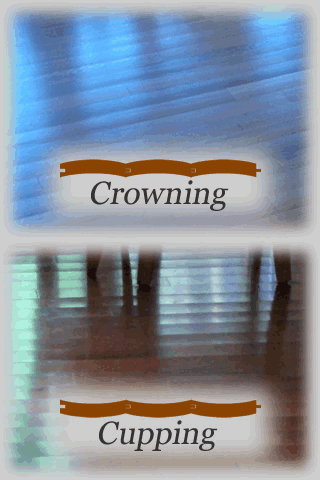
As mentioned previously, when a wood floor absorbs enough moisture, the boards swell against themselves to the point that they have nowhere else to go but up (or down). Apart from the most extreme cases of actual buckling, the most common manifestation of this occurring is either cupping or crowning. If the moisture is coming from underneath the floor, the bottom surface of the boards will expand more than the top surface and each board will develop a curl to it, which is called cupping. The boards appear concave when viewed from above, think of a child's drawing of the ocean. When the moisture above the floor is higher, the opposite reaction occurs, the top surface of the boards expand more than the bottom. In this case each board appears convex when viewed from above.
In the cases when this results from an abnormal change in the moisture content of the floor, it will usually flatten back out once equilibrium is reached. This is why one of the biggest mistakes one can make is sanding a cupped or crowned floor flat during a time when it's only temporarily deformed. This can result in the opposite effect when the floor returns to its original shape. For example, if a temporarily cupped floor gets sanded flat, it will appear to be crowned when it reaches equilibrium. This could always be rectified with yet another sand job but much of the life of the floor would be removed in the process, not to mention the hassle of having a floor sanded twice. A cupped or crowned floor should be assessed by a professional to determine whether it's only temporarily, or permanently deformed.
Winter months vs summer months
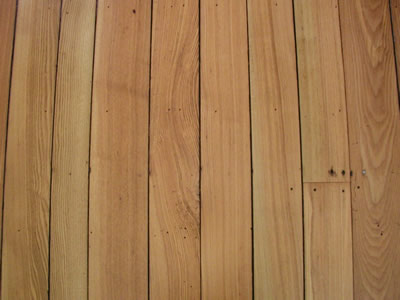
In areas with radical seasonal changes in environmental conditions, such as Indiana, often times a wood floor will change with the seasons too. You may notice slight gaps in the winter time that close up in the summer, or even a little bit of subtle cupping during the summer months that flatten out in the winter. Sometimes the floor has been installed for decades and there's just nothing that can be done about this. Given the choice, our stance is that the floor that opens a few gaps in the winter is preferable to one that develops cupping in the summer. This is why installing a wood floor in the middle of the winter when the furnace is drying the air in the home can sometimes be problematic. During a particularly dry spell, wood that has shrunk prior to installation gets "locked in place" when nailed down tight during the installation. Then when the Rh increases in the summer, the floor expands and cupping occurs. Contrast that with an installation during the peak humid time of year. When the dry season hits, the floor shrinks and gaps develop. This is all mitigated to some degree by regulating the Rh in the home as mentioned, but the time of year should still be considered when planning a wood floor installation. Always keep in mind that unlike other flooring materials, hardwood flooring changes with fluctuations in moisture, and special care must be taken in its use to avoid future problems that can detract from its beauty and functionality.

